A Strange UFO Tale from 1897 Texas is still a mystery
Long before the name “UFO” became widely used, a wave of reports of enigmatic, cigar-shaped flying objects that confused witnesses across the Midwest and South swept the United States in the late 19th century. The alleged crash at Aurora, Texas, on April 17, 1897, where a mystery ship is said to have collided with a nearby windmill and killed its unearthly pilot, who was subsequently interred in the town’s cemetery, is one of the most well-known tales from this era. This event, frequently referred to as “Texas’s Roswell,” combines early alien research with frontier culture, although it is still shrouded in mystery and uncertainty.
The Aurora incident was not unique. Between 1896 and 1897, American newspapers carried hundreds of reports of unidentified aerial phenomena that were characterized as light, elongated objects zipping through the night sky. When these “great airships” were spotted in places like California, Illinois, and Texas, there were rumors that secret inventors were testing new flying technology or even alien visitors. Before the Wright brothers’ powered flight in 1903, the public was captivated by such accounts that blended the excitement of scientific progress with the unknown.
Activity peaked in the spring of 1897, particularly in Texas. Witnesses claimed to have seen airships flying over farms and villages, sometimes even interacting with the residents. The small farming village of Aurora, located in Wise County about 20 miles northwest of Fort Worth, was already coping with crop failures, diseases, and the bypass of a railroad that had once promised prosperity. This was the situation where the claimed collision occurred.
According to a story by local correspondent S.E. Haydon that was published in the “Dallas Morning News” on April 19, 1897, the incident occurred on April 17 at approximately six in the morning. After passing over the town’s public plaza, the slow-moving, cigar-shaped airship turned north and collided with Judge J.S. Proctor’s farm windmill. The impact caused a “terrific explosion” that threw metallic debris over several acres and destroyed the windmill, water tank, and judge’s flower garden.
The single person inside the craft, the pilot, is reported to have been discovered dead amid the debris. According to Haydon’s account, the remains were “badly disfigured” but sufficient to establish that the creature “was not an inhabitant of this world.” Some sources speculated that the pilot was from Mars due to the period’s infatuation with the red planet, which was fueled by astronomer Percival Lowell’s claims about Martian canals. The body was described as little and alien in appearance, and hieroglyphic-like inscriptions found on papers amid the rubble were unintelligible.
The following day, the residents of Aurora reportedly gave the pilot a Christian burial in the neighborhood cemetery as a human gesture. A gravestone purportedly carved with a crude representation of the airship was erected at the burial, but it has since been taken or stolen. According to reports, the crash’s wreckage was poured into a neighboring well, which was later sealed.
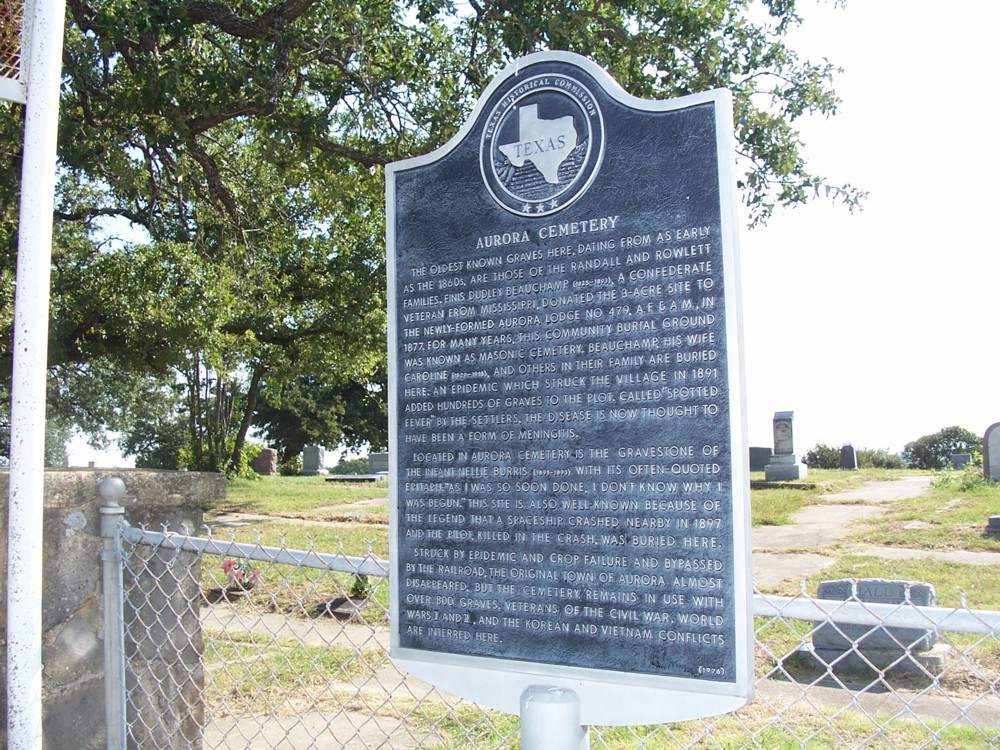
The tale swiftly vanished from the headlines, but it returned in the 1960s and 1970s when interest in UFOs grew following the 1947 Roswell incident. When the Mutual UFO Network (MUFON) investigated the site in 1973, they discovered strange metal readings around the alleged grave, but cemetery officials would not permit an exhumation. To honor the legend and the site’s broader history, which included the graves of Civil War warriors and victims of spotted fever, a Texas Historical Commission marker was placed at the Aurora Cemetery in 1976.
However, detractors assert that the event is most likely a fabrication. In a 1979 article in “Time” magazine, Aurora resident Etta Pegues said that Haydon fabricated the tale to emphasize the town’s demise as a result of disease and financial difficulties. There is currently no proof beyond the newspaper piece, and some academics argue that the airship wave was the result of a confluence of wild tales, misidentifications, and media sensationalism. The lack of physical artifacts, the grave marker’s disappearance, and the fact that debris was never kept all raise doubts.
Despite the controversy surrounding it, the Aurora UFO crash is widely known in popular culture. The cemetery attracts curious tourists and UFO enthusiasts, and the small town today embraces its unique status. It served as inspiration for documentaries, the 1986 film “The Aurora Encounter,” and even the 2002 short film “Aurora: The UFO Crash of 1897.” The story highlights how people have always been attracted by the stars and the possible visitors they may bring, whether this is genuine or not.
The Aurora incident serves as a reminder that mysteries in the sky have long aroused curiosity and discussion in the Lone Star State, even in this era of drones and satellites.