Canada’s Legendary Lake Monster of Okanagan Lake
For nearly a century, visitors and residents around British Columbia’s Okanagan Lake have whispered about a mysterious creature lurking in its deep, cold waters. Known as “Ogopogo”, this serpentine lake monster has earned a place alongside Scotland’s Loch Ness Monster as one of the world’s most famous cryptids. But unlike Nessie, Ogopogo’s story begins not with modern tourism but with the ancient traditions of the Syilx (Okanagan) First Nations, who have lived beside the 84-mile-long lake for thousands of years.
To the Syilx people, the being is called “n?x?ax?aitk?” (or N’ha-a-itk / Naitaka), translating roughly as “the sacred spirit of the lake” or “water demon.” Far from a bloodthirsty monster, it is viewed as a powerful guardian that protects the entire Okanagan Valley. Oral histories describe it living in underwater caves—particularly beneath Rattlesnake Island (nicknamed Monster Island)—and occasionally revealing itself. Offerings of tobacco, sage, or Kokanee salmon were traditionally made to honor the spirit and ensure safe passage across the water.
Early European settlers misinterpreted these stories, turning the spirit into a fearsome demon that demanded animal sacrifices. One chilling 1850s tale recounts settler John MacDougal watching his horses get sucked underwater by the creature. Pat Raphael of the Westbank First Nation emphasizes the cultural disconnect: “It’s not really a monster, it’s a spirit of the lake and it protects this valley from one end to the other.”
The catchy English name “Ogopogo” didn’t emerge from Indigenous lore. It comes from a 1924 British music-hall song popular in Vernon, B.C., with playful lyrics about a whimsical creature “with a little bit of head and hardly any tail.” By the 1920s, local tourism promoters adopted it to market the lake, transforming the sacred Ogopogo into a fun, marketable monster.
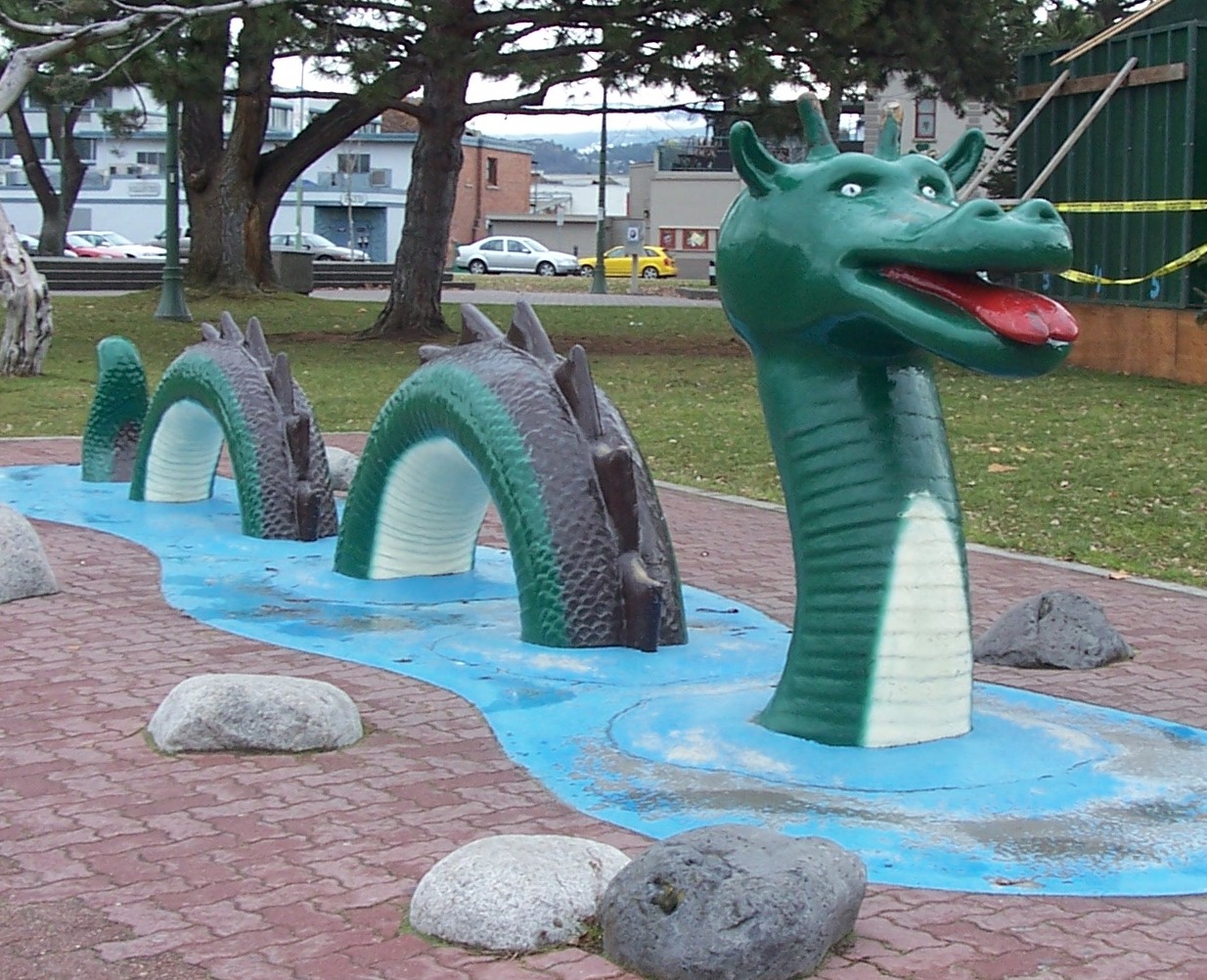

Witnesses typically describe Ogopogo as a 15–50-foot-long serpentine animal with smooth, dark skin, multiple humps, and a powerful tail that propels it at high speeds through vertical undulations. Some report a horse-like head, deer-like antlers, or even a wolflike face.
Sightings date back to the 19th century, but a handful stand out for their scale or evidence:
- 1926 Mass Sighting: One of the earliest and most widely reported events occurred at Okanagan Mission Beach. Around 30 cars full of people reportedly watched the creature simultaneously—enough witnesses to make headlines and cement Ogopogo in local lore.
- 1968 Arthur Folden Video: Driving along Highway 97, Folden pulled over and filmed a large, solid object creating a prominent wake about 100 meters offshore on calm water. Computer analysis later suggested a three-dimensional living creature. This footage remains one of the most compelling pieces of evidence.
- 1989 Ken Chaplin Video: Chaplin and his brother captured what appeared to be a 15-foot serpent-like animal slapping its tail near Bear Creek. The footage aired on “Unsolved Mysteries” and sparked international interest, though biologists suggested it might have been a beaver.
- 2008 Sean Viloria Photos: A tourist snapped multiple images of two humps and an object near a boat. Analysis on the television show “MonsterQuest” found no digital tampering, but skeptics proposed a tipped windsurfer.
- 2022 Viral Photo: A woman boating in October captured a bizarre orange object—roughly three feet across—with pointed “horns” protruding above the water and a triangular, wolflike face visible just below the surface. The object remained completely stationary despite waves, sparking widespread online debate. Experts later suggested possibilities like a large dead crayfish (claws mistaken for horns) or floating debris.
Skeptics point to everyday causes: groups of otters swimming in a line (creating a serpentine illusion), beavers, waterfowl, floating logs from the area’s timber history, or unusual waves caused by the lake’s thermal stratification (known locally as “Ogopogo waves”). National Geographic analyses of the 1968 and 1992 videos concluded the “creatures” were likely much closer to shore than witnesses realized—greatly inflating their estimated size.
Cryptozoologists and some researchers propose more exotic ideas: a surviving population of ancient serpentine whales (like the 40-million-year-old Basilosaurus), a large sturgeon, or even a mammal with paddle-like fins living in connected underground channels between lakes. Japanese sonar expeditions in the early 2000s and other independent investigations detected large underwater objects and caves but no conclusive proof. A $10,000 reward for clear evidence remains unclaimed.
Indigenous perspectives remind us that Ogopogo represents the spirit and power of water itself—a shapeshifter tied to life, cleansing, and respect for the natural world—rather than a literal flesh-and-blood beast.
Whether you believe in a living cryptid, a sacred spirit, or clever tricks of light and water, Ogopogo has become an indelible part of Okanagan culture. It stars as a hockey team mascot, appears in “The X-Files” and video games, and draws tourists to Kelowna’s waterfront. The Okanagan Heritage Museum now works with Syilx elders to reclaim the original respectful narrative.
Next time you stand on the shores of Lake Okanagan and see an unexplained wake slicing through the water with no boat in sight, you might just catch a glimpse of the valley’s ancient guardian. Or perhaps it’s simply the lake reminding us that some mysteries are best left unsolved—adding a touch of wonder to one of Canada’s most beautiful regions.