Canada’s Most Documented UFO Encounter
In the annals of unexplained phenomena, few cases have captured the public’s imagination quite like the Falcon Lake Incident. On May 20, 1967, in the remote wilderness of Whiteshell Provincial Park near Falcon Lake, Manitoba, Canada, an ordinary man named Stefan Michalak experienced what he described as a terrifying close encounter with an unidentified flying object. This event, involving physical injuries, mysterious radiation, and extensive investigations by authorities, remains one of the best-documented UFO cases in Canadian history, even as skeptics debate its authenticity.
Stefan Michalak, a 51-year-old industrial mechanic and amateur geologist from Winnipeg, was no stranger to the rugged terrain of Manitoba’s Precambrian Shield. Born in Poland, he had immigrated to Canada and often spent weekends prospecting for minerals like quartz and silver. On that fateful Victoria Day long weekend, Michalak had staked out claims in the area the previous year and returned to explore further. Equipped with basic tools, he set out into the woods, hoping to uncover valuable deposits.
Around noon on May 20, while chipping away at a quartz vein, Michalak was startled by a flock of geese erupting in loud honks. Looking up, he spotted two cigar-shaped objects hovering about 45 meters (150 feet) away, glowing with an intense reddish hue. One of the objects descended and landed on a flat rocky outcrop, transforming into a more disc-like shape approximately 35 feet (11 meters) in diameter and 10 feet (3 meters) high. The second object hovered briefly before ascending and disappearing into the sky.
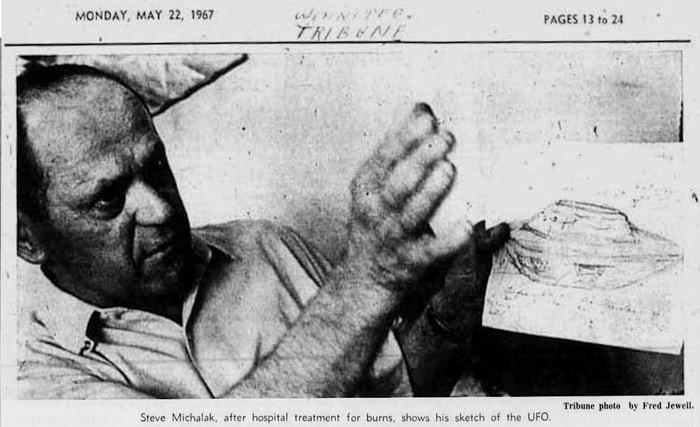
Intrigued and assuming it was a secret experimental aircraft, perhaps from the U.S. military, Michalak approached cautiously. He later sketched the craft, describing it as metallic with a smooth, seamless surface. As he drew nearer, he felt waves of warm air emanating from it, accompanied by a pungent sulfur odor and the whirring sound of motors. A hissing noise, like air escaping, filled the air. An open doorway revealed bright violet light inside, along with panels of flashing multicolored lights. Michalak heard muffled voices, which he described as high-pitched and human-like, but indistinguishable.
Believing the occupants might be in trouble, Michalak called out in English, offering mechanical assistance to what he thought were “Yankee boys.” Receiving no response, he tried Polish, Russian, German, and other languages, but only heard the mechanical sounds in reply. Donning his welding goggles for protection, he peered inside but saw no beings, just beams of light and intricate panels. Suddenly, three panels slid shut, sealing the door. When Michalak touched the craft’s hull, it was searing hot, melting the fingertips of his rubber gloves.
The object then rotated counter-clockwise. A grid-like exhaust vent aligned with Michalak’s chest and unleashed a blast of hot gas or air, propelling him backward and igniting his shirt, undershirt, and cap. He ripped off the burning clothes as the craft tilted, emitted a rush of air, and lifted off, vanishing into the sky. Disoriented, nauseous, and vomiting, Michalak stumbled through the forest for about 45 minutes before finding his way back to civilization.
Later that afternoon, around 3 p.m., Michalak flagged down RCMP Constable G.A. Solotki on Trans-Canada Highway 1. Appearing wild-eyed and burned, he warned the officer not to approach too closely, fearing contamination from radiation or a skin disease. He described seeing “two spaceships” but refused to show his burned shirt, claiming it was in his briefcase. Solotki noted a burn on Michalak’s hat and ash-like marks on his skin but detected no alcohol, though he suspected drinking. Michalak declined help and made his way back to his motel, then caught a bus to Winnipeg.
That evening, he sought treatment at Misericordia Health Centre for first-degree burns. Over the following days, his condition worsened: severe headaches, persistent vomiting, diarrhea, a 13-pound (6 kg) weight loss in three days, and a foul sulfur smell emanating from his pores. His chest and abdomen bore raised, grid-like sores in a pattern resembling the craft’s exhaust vent, described medically as irregular, blotchy marks the size of silver dollars.
Two days later, on May 22, Michalak contacted the Winnipeg Tribune to share his story, which was published the next day along with his sketches. He reported a circular indentation at the landing site where grass and leaves had been scorched away.
The incident quickly attracted official scrutiny. The Royal Canadian Mounted Police (RCMP), Royal Canadian Air Force (RCAF), Department of National Defence, Department of Health, and even U.S. authorities through the Condon Committee (a University of Colorado UFO study funded by the U.S. Air Force) launched investigations. Civilian groups like the Aerial Phenomena Research Organization (APRO) and the National Investigations Committee on Aerial Phenomena (NICAP) also got involved.
Initial searches on May 25 yielded no landing site, but Michalak returned privately on June 26 with a friend, recovering his burned shirt, a steel tape measure, and soil samples. Tests revealed high radioactivity in the soil and vegetation, particularly in a semicircle where moss had been removed, though levels were not dangerous. A rock crevice showed trace radiation, possibly from natural radium or artificial contamination like luminescent paint.
In October 1967, Michalak guided RCMP to burnt vegetation at the site. By November 1968, he claimed to have found metallic debris, 95% silver with slight radioactivity, analyzed as possibly dipped in pitchblende ore, raising hoax suspicions. Michalak’s burned clothing and tools tested negative for radiation initially, but later soil samples confirmed anomalies.
Medical evaluations at the Mayo Clinic in 1968 included psychiatric assessment, diagnosing the recurring burns (which reappeared in a uniform grid pattern) as factitious disorder, self-inflicted, without evidence of mental illness. Skeptics pointed to inconsistencies, such as Michalak’s denial of drinking despite witness reports of him consuming beers the night before, and suggested the incident might cover an accident or protect a mining claim.
Canadian Minister of National Defence Léo Cadieux announced in November 1967 that the investigation report would remain classified. The U.S. Air Force and other authorities concluded there was no evidence of extraterrestrial involvement, labeling the case unexplained but likely terrestrial in origin.
The encounter profoundly affected Michalak’s family. His son, Stan Michalak, who was nine at the time, recalls the chaos vividly: “I walked into the bedroom, there was a huge stink in the room, like a real horrible aroma of sulphur and burnt motor. It was all around and it was coming out of his pores. It was bad.” The family’s modest home in Winnipeg’s River Heights became a circus of media, investigators, and curious onlookers. Phone calls rang constantly, people camped on the lawn, and Stan faced bullying at school, with peers questioning his father’s sanity.
Stefan, a former military policeman with a strong sense of duty, felt compelled to report the incident to warn others but later regretted the publicity. He never claimed aliens, insisting it was a military craft, and his story remained consistent until his death in 1999 at age 83. “If you asked him what it was he saw, he could describe it in intimate detail but he would never say, ‘Oh, it was definitely extraterrestrials,’ because there was no evidence to prove that,” Stan noted. In 2017, Stan co-authored “When They Appeared” with UFO researcher Chris Rutkowski to mark the 50th anniversary, defending his father’s integrity: “If Dad hoaxed this… he was a freakin’ genius.”
The Falcon Lake Incident endures as a cornerstone of UFO lore, featured in books, documentaries, and podcasts. A commemorative coin was even issued by the Royal Canadian Mint in 2018. While skeptics argue for a hoax or mundane explanation, perhaps involving alcohol, an allergic reaction, or deliberate fabrication, proponents highlight the physical evidence, consistent testimony, and lack of motive for deceit. As Stan Michalak reflects, the official verdict remains “unexplained,” cementing its place as Canada’s premier UFO case.